Introduction: Guesswork is a Landmine for Your After-Sales Service
In B2B audio bidding and procurement, speaker quantity is often where a project starts to go wrong. A gymnasium, theater, or corporate lecture hall may look simple on a floor plan, but once the last row sits 30 meters or more from the hang point, “add a few more boxes” is not a design method.
If the system is under-specified, coverage gets patchy, speech loses weight at the back, and the project can fail acceptance testing. In worse cases, the operator keeps pushing the system until the amplifiers clip or go into thermal protection. If the system is over-specified, the BOM gets heavy and the bid loses its price position before the technical proposal is even discussed.
I see the same shortcut on many projects: “The room is big, so use 12 speakers.” That may be right, or it may be money thrown at the ceiling. From years of handling venue system designs for EGT Audio (Leiyu Sound Device Factory), I prefer to start with four numbers: target SPL, farthest listener distance, cabinet output, and amplifier headroom. The math is not complicated. What matters is using it before the quotation is locked.
Core Technical Principles: Back-Calculating from Furthest Distance to Max SPL
A professional sound reinforcement design is usually worked backward from the farthest useful listening position. The basic inputs are Target Sound Pressure Level (SPL), Maximum Coverage Distance, Loudspeaker Sensitivity & Rated Power, and the Inverse Square Law of Acoustics.
1. Establish the Target SPL Based on Application
Different rooms need different operating levels. A conference hall does not need the same peak level as a live stage, and a gymnasium used for sports commentary sits somewhere in between. The system also needs enough peak margin so normal speech and music transients do not push the signal into distortion.
| Application Scenario | Recommended Continuous SPL | Required Peak Margin | Target Peak SPL ($SPL_{Target}$) |
|---|---|---|---|
| Corporate Conference Hall / Lecture Room | 90 dB - 95 dB | + 6 dB | 101 dB SPL |
| Multi-Function Ballroom / Auditorium | 95 dB - 100 dB | + 10 dB | 110 dB SPL |
| Indoor Gymnasium / Outdoor Live Stage | 100 dB - 105 dB | + 12 dB | 117 dB SPL |
Pro Field Warning: Do not size the system only from average SPL. Speech and music both contain fast peaks. If the design has no 6 dB to 12 dB headroom margin, a normal vocal shout or drum hit can drive the system into clipping. The listener hears harshness first; the drivers feel the heat next.
2. The Inverse Square Law and Distance Decay
Sound level drops as distance increases. The amount of loss depends on how the source behaves in the room:
- Point Source Loudspeakers (e.g., standard professional full-range wooden cabinets): Sound pressure level drops by 6 dB for every doubling of distance ($6\text{ dB}$ loss per doubling).
- Line Source Loudspeakers (e.g., Line Array Systems): Due to their cylindrical wave propagation design, the acoustic energy drops by only 3 dB for every doubling of distance within its near-field range.
This is the main reason Line Array Systems are used in medium and large venues. They hold level over distance better than a single point source, as long as the array length, splay angles, and mounting height are chosen correctly.
3. Calculating Maximum Output SPL
Most professional loudspeaker datasheets list sensitivity at ($1\text{W}/1\text{m}$) and a maximum SPL value. The basic calculation is:
$\text{Max SPL} = \text{Sensitivity (1W/1m)} + 10 \times \log_{10}(\text{Continuous Rated Power})$
For example, the EGT Nezha Series E-LY212 Dual 12-inch Passive Line Array Speaker in the “2026 EGT E-CATALOG.pdf” has LF sensitivity of $100\text{ dB}$ ($1\text{W}/1\text{m}$) and continuous power handling of $800\text{W}$.
Using the formula:
$100 + 10 \times \log_{10}(800) \approx 100 + 29 = 129\text{ dB}$
The cataloged continuous maximum output is higher: 133 dB SPL for the LF section and 135 dB SPL for the HF section. That difference comes from the complete cabinet design, including horn loading, waveguide efficiency, and driver arrangement. For design work, I treat the published $1\text{-meter}$ maximum SPL as the starting point, then subtract the distance loss.
Real-World Case Study: 1,000-Seat Multi-Purpose Gymnasium
Take a common B2B project: an indoor sports arena, 40 meters long and 25 meters wide. The farthest audience position is 35 meters from the main loudspeaker rigging point. The system needs to deliver 110 dB SPL peak at that position for sports commentary, playback, and event use.
Step 1: Calculate Distance Attenuation at 35 Meters
For this room, a line array is the reasonable starting point because the throw distance is long. In the first pass, I still calculate with standard spherical loss so the estimate does not depend on an optimistic array assumption:
$\Delta\text{SPL} = 20 \times \log_{10}(35\text{ meters}) \approx 31\text{ dB}$
So a source measured at $1\text{ meter}$ will be roughly $31\text{ dB}$ lower at the farthest seat before room reflections, array interaction, and aiming are considered.
Step 2: Determine the Single-Cabinet Contribution at the Longest Throw
If one E-LY212 cabinet is used as the reference source (LF Max SPL = $133\text{ dB}$), its level at 35 meters is:
$133\text{ dB} - 31\text{ dB} = 102\text{ dB SPL}$
That is about 8 dB below the $110\text{ dB}$ project target. One cabinet is not enough, even before we talk about vertical coverage and seat-to-seat consistency.
Step 3: Scale Loudspeaker Quantity for Acoustic Coupling
When identical passive cabinets are arrayed in a vertical hang, they add acoustic output through coupling and increased total amplifier power. The real gain depends on frequency, spacing, splay, and how much of the array is actually covering the same listener. For procurement calculations, I use the conservative $3\text{ dB}$ gain per doubling:
- 1× E-LY212 at furthest point = $102\text{ dB}$
- 2× E-LY212 array combination = $102 + 3 = 105\text{ dB}$
- 4× E-LY212 array combination = $105 + 3 = 108\text{ dB}$
- 8× E-LY212 array combination = $108 + 3 = 111\text{ dB}$
Calculation Conclusion: The clean mathematical answer is that a single cluster needs more than four boxes if one hang alone must reach $110\text{ dB}$ at the farthest seat under this conservative model. In an actual left/right venue layout, the final choice also depends on audience width, trim height, vertical aiming, and how much overlap exists between the two hangs. For this size of gymnasium, I would normally specify 2 clusters (Left/Right), each containing 4× E-LY212 cabinets (8 units total) as the baseline quotation, then confirm the far-row margin in acoustic simulation or on-site tuning. If the rear audience area is mainly covered by one hang, or if the venue expects higher music playback levels, the safer specification is 6 cabinets per side.
Hardware Matching Guide: The Amplifier Headroom Law
Once the speaker count is set, amplifier matching decides whether the system can deliver the design on a real job site. Many failures that look like “bad speakers” are actually amplifier headroom problems.
The Thermal Trap of Under-Powering (“The Small Horse pulling a Big Cart”)
A common procurement mistake is this assumption: “An $800\text{W}$ speaker can use a $600\text{W}$ amplifier, as long as the operator does not turn it up too much.” In the field, that thinking burns drivers.
Under-powering is dangerous because the operator usually compensates by raising the mixer output or processor gain. Once the amplifier runs out of voltage swing, it clips. The rounded sine wave becomes flat at the top and bottom, and the signal starts to behave more like a square wave than music or speech.
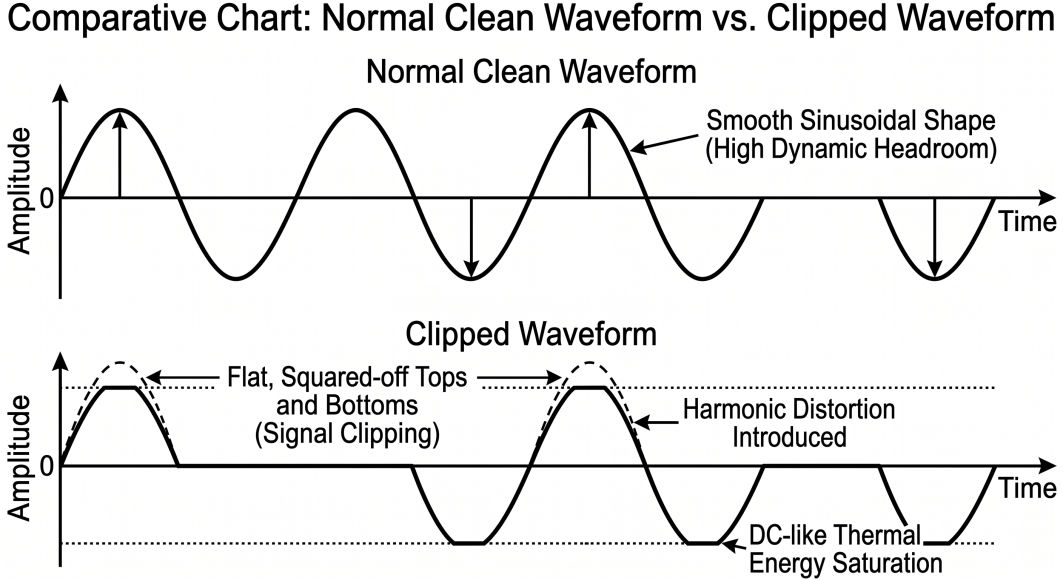
A clipped waveform creates high-frequency harmonics and sustained thermal energy. The passive crossover sends a large share of that stress to the compression driver. The voice coil in a high-frequency driver is small, so it does not take long for heat to build. This is why a weak amplifier driven into clipping can destroy a tweeter faster than a stronger amplifier operated cleanly.
The Solution: 1.5× to 2× Continuous Power Formula
For professional installations, the amplifier’s rated continuous output should usually be 1.5 to 2 times the loudspeaker’s continuous power handling.
For the Nezha E-LY212 line array box ($800\text{W}$ continuous at $8\text{ ohms}$ nominal impedance), the recommended amplifier output is roughly 1200W to 1500W per channel into an 8-ohm load.
In the “2026 EGT E-CATALOG.pdf”, the EGT BH Series Professional Power Amplifier, Model BH1500 fits this range.
Exact Power Matching: The BH1500 delivers 1500W × 2 channels at 8 ohms under standard stereo loads.
This satisfies the 1.5× to 2× headroom rule for the E-LY212 cabinet. Its Class H topology also suits high-power fixed installations where efficiency and heat control matter. The listed Damping Factor of >223 gives the amplifier firm control over the low-frequency voice coil, which helps reduce loose low-end response in reflective spaces such as gymnasiums.
For stage monitors or fill speakers using lower-power $8\text{-ohm}$ cabinets, the EGT AK Series four-channel amplifiers (e.g., AK41000, 1000W × 4 @ 8 ohms) can be a practical choice. The four-channel format saves rack space and cabling on distributed zones, while the toroidal transformer and protection circuits (soft start, short circuit, DC protection, and clip limiting) are useful for long-running installed systems.
Pro-Engineer Practical Checkpoints: Field Pitfalls to Avoid
Before the equipment list is finalized, I always check two details that are easy to miss in the office and expensive to fix after installation:
The 2-Ohm Overloading Trap:
Installation crews sometimes try to save amplifier channels by connecting three or four $8\text{-ohm}$ passive speakers in parallel on one amplifier channel. Four $8\text{-ohm}$ cabinets in parallel bring the total load down to 2 ohms. Many professional amplifiers can survive a 2-ohm load for a while, but continuous operation at that impedance produces serious heat and can trigger protection or current limiting. Field Rule: Keep parallel loading capped at two 8-ohm speakers per channel (maintaining a stable 4-ohm load) to preserve safety margins.Cable Gauge Power Losses:
Do not pair high-power loudspeakers and high-damping amplifiers with thin $1\text{ mm²}$ copper-clad aluminum cable. Long runs with small cross-sections add resistance, waste amplifier power, and reduce damping at the driver. For cable runs above 20 meters and speaker power above $500\text{W}$, specify 2.5 mm² (or thicker) high-purity Oxygen-Free Copper (OFC) professional speaker cables. It is a small line item compared with replacing drivers or explaining weak bass during acceptance testing.
Summary
A reliable professional sound system is not built from guesswork. Start with the required SPL at the farthest seat, subtract the distance loss, compare the result with the cabinet’s maximum SPL, and then add enough cabinets and amplifier headroom to keep the system out of clipping.
For procurement teams, the useful chain is still simple: Target SPL $\rightarrow$ Distance Attenuation $\rightarrow$ Cabinet Max SPL $\rightarrow$ Amplifier Headroom Scaling. If those four numbers are clear in the proposal, the equipment list becomes easier to defend, easier to tune, and much less likely to cause trouble after handover. EGT Audio (Leiyu Sound Device Factory) designs its commercial sound systems around measured output, realistic power matching, and the kind of safety margin that matters once the room is full.