In the mobile production rental business, gear sitting in a dark warehouse doesn’t pay the rent. Every speaker, power amplifier, and flight case must earn its keep. Over my years in the field, I’ve seen countless regional rental houses make the same critical error: buying niche, single-purpose audio systems that only get booked twice a year for specific large-scale gala events.
Modern B2B event procurement teams and engineering contractors are highly analytical. Research shows that up to 89% of B2B buyers conduct comprehensive online research before ever picking up the phone to talk to a supplier. They aren’t looking for marketing fluff; they want robust, verifiable technical specs, flexible deployment options, and fast setup times that minimize on-site labor costs.
If you want your rental company to maintain a high-return-on-investment (ROI) toolkit, your audio assets must master the art of adaptation.
The Fleet Versatility Equation: Active vs. Passive Assets
When configuring an event fleet, the classic debate is between active (self-powered) systems and passive boxes with external amplifier racks. In a fixed installation, a passive system often wins due to centralized maintenance. But for a mobile production company dealing with varied event sizes—from a 200-person indoor corporate product launch on Tuesday to an outdoor food festival on Saturday—the rules change completely.
A purely passive line array setup requires heavy amp racks, complex speaker multi-core cables, and a lot of math on-site to ensure impedances match up perfectly across bi-amped or tri-amped configurations. For a lean setup crew, this eats up valuable time. Conversely, a modern active system streamlines processing, amplification, and protection boundaries inside the box.
Field Pitfall Warning: The Unstable Power Factor Killer
Over years of troubleshooting outdoor stages, I’ve found that the biggest killer of digital amplifiers isn’t over-driving the input signal—it’s bad generator power. When a mobile production crew runs long power runs from a fluctuating on-site generator, the voltage drops. A standard amplifier under low voltage draws massive current to maintain output, overheating the power supply and tripping thermal shutdown right in the middle of a show.
To combat this, look for digital amplification modules that integrate active Power Factor Correction (PFC). A power supply with PFC automatically adapts to global voltages (typically 100V to 240V AC), smoothing out current spikes and maintaining rock-solid dynamic performance even when running off a questionable generator on a temporary outdoor stage.
Smart Master-Slave Architectures: The Real High-ROI Sweet Spot
If your rental inventory consists only of heavy, self-powered line array modules for every single box in the array, you face a different problem: your rig becomes incredibly heavy to fly, and your upfront capital expenditure skyrockets because you’re paying for a digital signal processor (DSP) and a Class-D power module inside every single enclosure.
The optimal configuration for a flexible rental fleet is a Master-Slave Active/Passive Hybrid Structure. In this ecosystem, a high-power active subwoofer serves as the central engine block. It houses a multi-channel Class-D amplifier with robust processing capabilities and power outputs capable of driving not only its own internal low-frequency driver but also multiple passive companion full-frequency line array boxes.
Let’s look at how this changes your transportation logistics and setup workflow.
Technical Illustration: Master-Slave Power & Signal Distribution
Below is a schematic showing how a single integrated active subwoofer engine efficiently powers a multi-box line array stack, eliminating the need for external amp racks and reducing field deployment times.
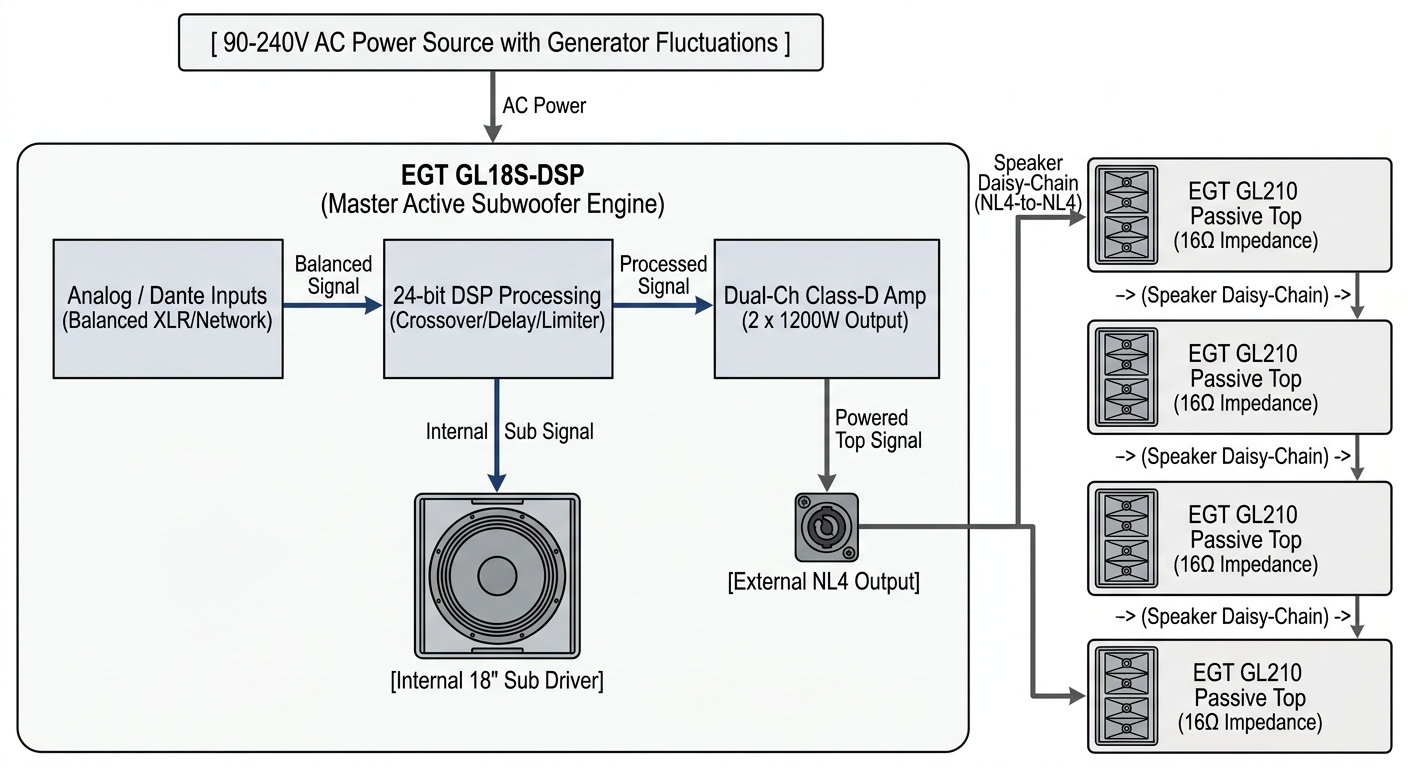
By leveraging a high-impedance (such as 16-ohm) design on the passive full-frequency top boxes, you can comfortably daisy-chain up to four mid-high enclosures off a single dedicated amplifier channel on the master subwoofer. This design cuts down your amp-rack weight to zero, drastically slashes your cable inventory, and allows you to split the system into smaller, independent ground-stacks for minor breakout rooms when needed.
Real-World Asset Blueprint: Scaling from Small Corporate to Medium Outdoor
To give your business maximum market reach, your audio assets should easily scale across different system architectures depending on the gig profile.
Solution A: The Integrated Ground-Stack (Fast-Turnaround Corporate Events)
For standard corporate meetings, hotel ballrooms, or small outdoor community gatherings, look toward compact, self-contained systems with a small physical footprint. A great example of a fast-setup, high-efficiency system is the EGT EASY-1018 Active Electric Robotic Lifting Line Array System.
The Setup Advantage: It combines a single 18-inch ultra-low subwoofer and a double 10-inch coaxial mid-high system into a single integrated unit featuring a motorized lifting mast. Instead of a three-person crew sweating over manual crank stands or rigging towers, a single technician rolls the unit into place, connects power and signal, and hits the electric lift switch.
The ROI Logic: Labor costs on-site are a direct drain on a rental contract’s profitability. Systems that reduce setup time from two hours down to fifteen minutes allow your crew to handle multiple venue drop-offs in a single day.
Solution B: The Modular Cross-Rental Fleet (Concerts & Festivals)
When your rental company steps up to handle live musical performances or medium stadium reinforcement, your inventory needs the acoustic muscle of a true modular line array, such as the EGT Nezha E-LY212 Series or the VK Series.
| Operational Metric | Compact Active Solution (e.g., EASY-1018) | Modular Passve Rig (e.g., Nezha E-LY212 + E-LY218S) |
|---|---|---|
| Primary System Target | Small/Medium Corporate, Private Parties, DJs | Live Festivals, Stadiums, Large Auditoriums |
| Acoustic Configuration | Coaxial 10” Tops + 18” Subwoofer Base | Dual 12” Bipolar Tops + Dual 18” High-Output Subwoofers |
| Max SPL Capabilities | 129 dB | 135 dB (Tops) / 139 dB (Subs) |
| Cabinet Construction | 18mm High-Density Multi-layer Plywood | Premium Birch Plywood with Tour-Grade Textured Paint |
| DSP Integration | Built-in Cirrus Logic 24-bit/48kHz, Mconsole Control | Managed via External DSP and Networked Amp Racks |
For massive throw distances, a passive dual 12-inch line array box like the Nezha E-LY212 employs an advanced acoustic lens waveguide alongside a horn geometry design. This physical design limits phase cancellation and focuses acoustic energy directly toward the back of a crowd rather than spilling sound onto the stage or ceiling.
Fleet Longevity: Protecting Your Investments from the Road
A high-ROI tool is also one that withstands the physical abuse of the rental environment. Stagehands drop boxes, tour trucks bounce across bumpy roads, and sudden summer rainstorms can threaten outdoor stages.
When auditing your next equipment upgrade, prioritize these two non-negotiable physical characteristics:
Tour-Grade Polyurea Waterproof Paint: Avoid generic painted or carpeted enclosures. True industrial-grade polyurea coatings are chemically bonded to the plywood enclosure, creating a waterproof and highly scratch-resistant shield that protects the timber from splitting or swelling when exposed to damp environments.
Robust Network Telemetry: If you are deploying networked active speakers like the EGT VKX DSP Series, make sure your technician utilizes software monitoring tools (such as Mconsole via TCP/IP or USB interfaces). Being able to monitor real-time operating temperatures and output power levels straight from the front-of-house (FOH) mixing console ensures your crew can catch a clipping amplifier or an overheating coil long before a driver fails on stage.
Engineering Summary for Fleet Procurement
Actionable Asset Strategy :
To secure elite equipment ROI, design a modular audio fleet based on multi-use platforms. Choose active subwoofers with active Power Factor Correction (PFC) capable of driving passive extension enclosures to minimize your transport volume and reduce cabling labor. Ensure all speaker enclosures feature rugged polyurea finishes and real-time DSP monitoring via network telemetry to prevent field failures and prolong operational life.