A common dilemma in audio system proposals is whether to specify neodymium-loaded enclosures or traditional ferrite systems, and how to justify the associated price variance to clients.
The loudspeaker driver magnet does not produce acoustic energy by itself. It establishes a static magnetic field across a narrow voice coil gap, translating alternating electrical current from the power amplifier into mechanical cone movement. The choice of magnetic material—Neodymium Iron Boron ($NdFeB$) versus Strontium Ferrite ($SrFe$)—directly impacts loudspeaker enclosure weight, thermal power compression, structural rigging limits, and total project budgets.
Magnetic Flux Density vs. Mass: What Happens in the Gap?
The primary advantage of neodymium lies in its maximum energy product ($(BH)_{\max}$), which is roughly eight to ten times higher than that of standard strontium ferrite.
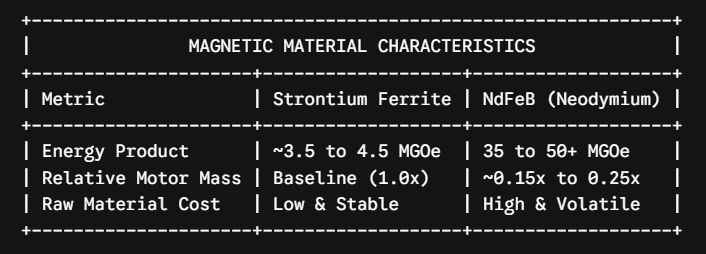
Because neodymium concentrates magnetic flux in a compact footprint, acoustic engineers can achieve a high force factor ($BL$ product) without mounting heavy iron assemblies to the back of the cone basket.
In high-frequency compression drivers, this magnetic density allows for ultra-compact phase plugs and shorter horn throats. The voice coil accelerates with lower inertia, producing crisp transient attacks, extended top-end air, and minimal harmonic distortion on vocal sibilance. In mid-bass drivers, a high $BL$ motor ensures precise transient control, preventing sluggish, overhang resonance during sudden acoustic peaks.
The Thermal Trade-Off: Heat Sink Mass vs. The Curie Point
While neodymium drivers excel in power-to-weight ratios, magnetic thermodynamics introduce practical operational constraints.
1 | <svg xmlns="http://www.w3.org/2000/svg" viewBox="0 0 760 380" width="100%" height="auto" style="background-color: #fcfcfc; border: 1px solid #e2e8f0; font-family: -apple-system, BlinkMacSystemFont, 'Segoe UI', Roboto, sans-serif;"> |
When an amplifier pumps hundreds of watts of continuous pink noise into a loudspeaker, approximately 95% to 98% of that electrical energy turns into heat inside the voice coil. As voice coil temperature climbs past 150°C, direct-current resistance ($R_e$) increases, causing power compression—the audible phenomenon where extra amplifier wattage produces more heat rather than increased sound pressure level.
- Ferrite Heat-Sinking: Ferrite magnets are attached to massive steel pole plates and backplates. This bulk serves as an effective, passive heatsink. It takes considerable time to saturate this thermal mass, meaning output drops gradually and predictably over long concert sets.
- Neodymium Heat Sensitivity: Neodymium has a lower Curie temperature (around 310°C to 350°C) than ferrite (over 450°C). If an unvented neodymium motor reaches temperatures above 140°C, it risks thermal demagnetization—permanently reducing the driver’s magnetic field strength.
Modern high-output neodymium drivers resolve this limitation with CNC-machined radial heat sinks and forced-air voice coil venting. High-velocity air is drawn through center pole vents with every cone stroke to dissipate thermal energy. However, building reliable neodymium subwoofers requires robust convective motor venting.
Rigging Limits, Truck Pack, and Structural Load
In touring and large-scale permanent installations, physical weight directly dictates feasibility and cost.
Consider a municipal auditorium with a maximum ceiling beam working load limit (WLL) of 350 kg per rigging point:
- A standard 8-box array of dual-10” ferrite line array enclosures often averages 38 kg to 42 kg per cabinet. Eight boxes plus flyware, steel shackles, and motor chains will quickly reach 360 kg to 380 kg, exceeding structural safety limits.
- In contrast, an optimized dual-10” all-neodymium enclosure weighs roughly 24 kg to 26 kg. An 8-box array totals around 230 kg with rigging hardware, leaving comfortable structural safety headroom.
On commercial tours, shaving 400 kg off a flown sound system cuts fuel consumption, reduces truck-pack volume, and lets a two-person stage crew handle load-in without risking back injury.
Real-World Engineering: Driver Application at EGT Audio
Driver motor topology is an engineering choice tailored to use cases rather than a simple metric of superiority. System designers must weigh physical installation dynamics against client budgets.
1. Flown Line Arrays: The All-Neodymium Approach
The EGT VK210 line array module employs dual 10-inch low-frequency drivers (75 mm voice coil) and dual 1.4-inch exit compression drivers (75 mm voice coil) powered entirely by neodymium magnets. Despite delivering 135 dB continuous SPL (140 dB Peak), the cabinet weighs just 25 kg. This compact footprint allows contractors to fly six to twelve cabinets from standard lightweight aluminum lighting trusses without requiring heavy motor hoists.
2. Touring Hybrid Systems: Precision in the Air, Mass on the Ground
The EGT Nezha E-LY212 utilizes dual 75 mm voice coil neodymium high-frequency compression drivers paired with dual 12-inch woofers. Neodymium HF drivers yield rapid transient response across long wave-guides to carry intelligibility to the back of an arena.
However, when pairing this system with subwoofers like the EGT E-LY218S (dual 18-inch ferrite subwoofers, 86 kg), ferrite motors are an intentional design choice. On arena floors or under stages, cabinet weight provides grounding stability, keeping high-SPL sub enclosures from mechanically walking across stages while providing massive thermal dissipation for sustained sub-bass synth basslines.
3. Budget-Conscious Permanent Installations: Heavy Duty Ferrite
When designing an auditorium, gymnasium, or house of worship system where speakers bolt permanently to steel girders or concrete pillars, cabinet mass rarely limits the design.
The EGT VKX210L-DSP active line array leverages custom-engineered ferrite magnet drivers (120 mm magnet HF and 156 mm magnet LF). Because the boxes are hung once and never moved, trading the mass savings of neodymium for ferrite saves the integrator 25% to 35% in raw transducer procurement cost without compromising acoustic sensitivity, power handling, or DSP limiting performance.
Contractor Pitfall Warnings: Avoid Common Field Mistakes
- Pitfall 1: Specifying Neodymium for Fixed Concrete Installations
Do not waste an end-user’s budget on neodymium if the cabinets will hang permanently from concrete pillars or unconstrained steel joists. Reallocate those savings toward better power distribution, premium system cabling, or DSP room-tuning measurement. - Pitfall 2: Neglecting High-Pass Filters (HPF) on Compact Neodymium Subs
Because neodymium voice coils rely heavily on cone motion for convective cooling, running deep frequencies below cabinet port tuning ($F_b$) causes voice coil excursion without effective airflow. Thermal buildup can occur rapidly. Always set an electrical high-pass filter (typically Butterworth 24 dB/octave or Linkwitz-Riley 48 dB/octave) within 3 Hz to 5 Hz of the enclosure’s lower tuning limit. - Pitfall 3: Cable Resistance Compounding Power Compression
Long, undersized speaker cables (such as 16 AWG runs exceeding 30 meters) introduce significant loop resistance. When driver voice coils heat up during an event, this additional line resistance degrades the amplifier’s effective damping factor, resulting in muddy, uncontrolled low-end reproduction. Use at least 12 AWG (or 10 AWG for high-power subwoofers) to maintain dynamic control.
Engineering Selection Matrix

System engineering is about selecting the right tool for the environment. When hanging weight, transport cubic footage, and high-frequency wave-guide speed are paramount, neodymium remains the industry benchmark. For permanent wall-mounted speech systems, fixed club installations, and ground-shaking floor subwoofers, robust ferrite motors deliver consistent acoustic output, thermal reliability, and better project ROI.