The Death of the “Blind” Amplifier Rack
For decades, commissioning an arena or stadium audio system meant sending an engineer sprinting backstage every twenty minutes to smell the amp racks, check thermal LEDs with a flashlight, or tweak analog rotary pots with a screwdriver. If a transducer impedance drifted or an amplifier channel clipped during the climax of a show, Front of House (FOH) rarely found out until the audio distorted or a voice coil burnt out.
The industry has moved past passive “dumb iron.” Modern installations and touring rigs demand active intelligence: Smart Amplifiers that integrate high-efficiency Class-D amplification, dedicated 24-bit/48 kHz DSP engines, and bidirectional network telemetry into a single manageable ecosystem.
Whether managing a 32-box outdoor line array or a 12-zone corporate convention center, remote cluster control over TCP/IP and digital audio buses has turned power management from an operational liability into a precise, real-time science.
Core Architecture: The Brains Behind Networked Amplification
A true smart amplifier is not just an analog power stage with an Ethernet jack tacked onto the backplate. It is a distributed computing node designed around three unified stages:
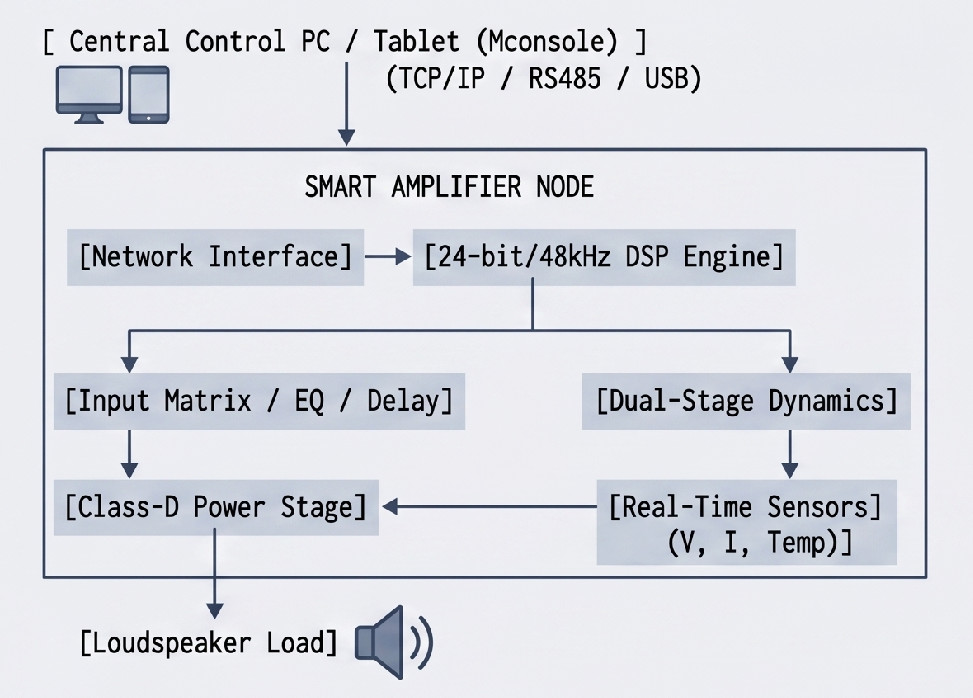
1. Real-Time Telemetry & Hardware Feedback
Unlike legacy systems that only report catastrophic failure (protect mode), smart amplifiers constantly broadcast their operational health over the control network:
- Load Impedance Sweeping: Continuously calculates voltage-to-current ratios at the output terminals, instantly flagging open lines (blown drivers) or partial shorts (melted voice coil layers).
- Thermal Rail Tracking: Measures real-time heatsink and MOSFET junction temperatures, enabling variable-speed fan curves to ramp up before thermal throttling occurs.
- Mains Voltage & PFC Stability: Monitors AC grid sag during massive sub-bass transients, dynamically adjusting power supply draw via Power Factor Correction (PFC) modules.
2. Advanced Multi-Stage Dynamics Protection
Smart DSP monitoring software replaces crude analog clip limiters with coordinated, multi-layer protection profiles:
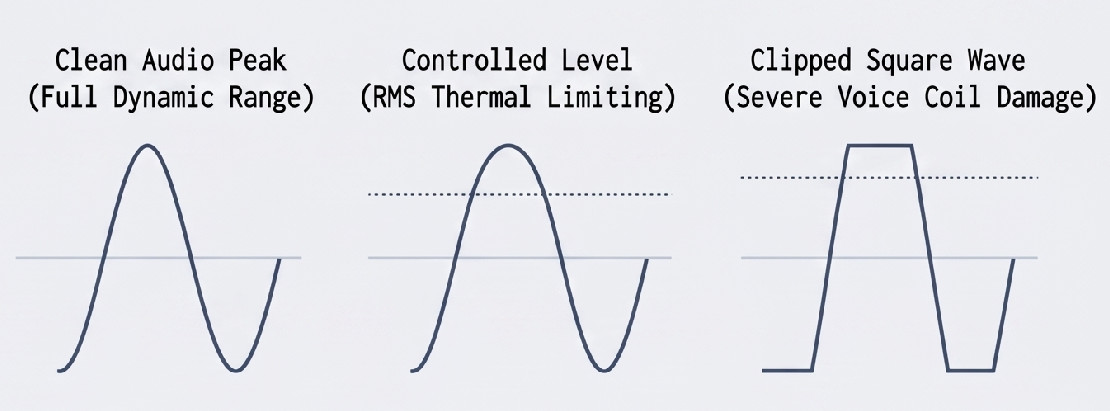
- RMS Compression (Thermal Protection): Simulates long-term heat buildup in the transducer’s voice coil, gently clamping continuous power over extended passages without destroying musical transients.
- Peak Limiting (Excursion Protection): Uses look-ahead peak-cut circuitry with sub-millisecond attack times to prevent driver cones from exceeding mechanical Xmax limits.
Centralized Management: Software in Action
In mission-critical deployments, managing hardware one-by-one is unacceptable. Modern DSP suites—such as EGT Audio’s proprietary Mconsole Software—allow technicians to discover, address, and manipulate an entire venue’s amplification infrastructure from a single master dashboard.
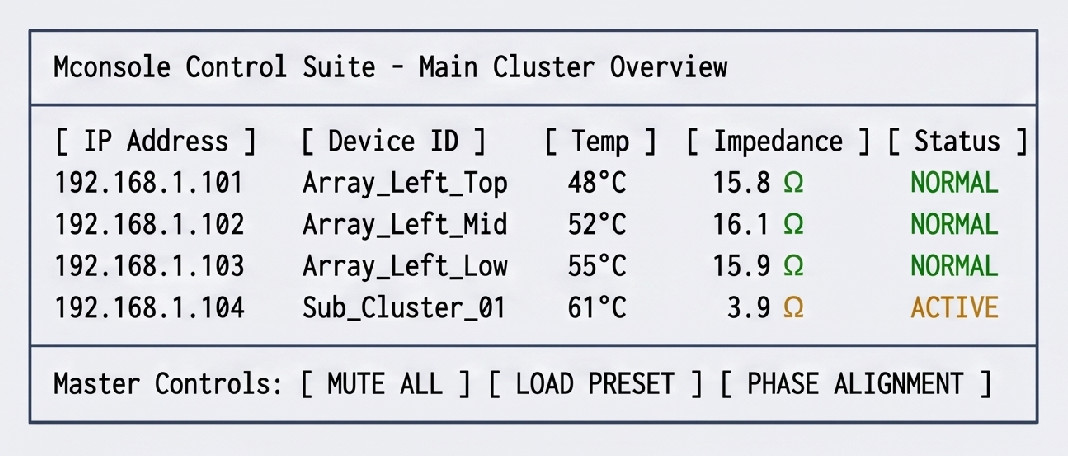
Key Centralized Operations:
Global Cluster Zoning: Link arrays into logical groups (e.g., Main Hang, Side Fills, Under-Balcony Delays). Adjusting high-frequency shelving across an entire 12-box line array takes two seconds rather than twelve individual physical adjustments.
Multi-Point Phase Alignment: Implement up to 120 ms of global input delay alongside individual output delay channels directly within active systems like the EGT VKX210L-DSP active line array, achieving seamless acoustic time alignment between mains and auxiliary delays.
Live System Loggers: Export complete event logs showing peak SPL events, temperature history, and AC line drops to verify system integrity for warranty and client reporting.
3 Field Pitfalls Every Systems Integrator Must Avoid
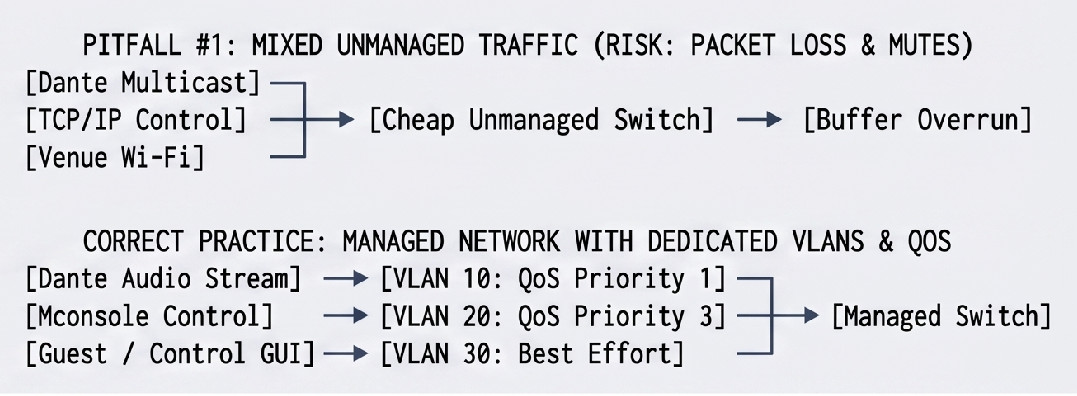
Pitfall 1: Mixing Dante Audio and Remote Telemetry on Cheap Unmanaged Switches
The Trap: Running unmanaged office-grade gigabit switches to connect audio-over-IP streams (such as Dante) and amplifier TCP/IP monitoring packets on the same broadcast domain. Heavy multicast audio traffic easily floods low-tier switch buffers, choking telemetry packets and causing DSP control software to lose connection during the show.
The Solution: Always deploy managed Layer-2/Layer-3 enterprise switches. Segment control data (Mconsole/Telnet) and real-time audio streams into separate VLANs with proper IGMP Snooping and QoS prioritization configured.
Pitfall 2: Double Limiting via Inconsistent Gain Staging
The Trap: Setting an aggressive digital limiter on the upstream FOH console or digital matrix while simultaneously engaging the amplifier’s internal peak limiter at a lower voltage threshold. This causes double compression artifacts, severe phase distortion around the crossover knee, and premature loss of dynamic headroom.
The Solution: Calibrate system sensitivity systematically. Leave system protection dynamics to the amplifier’s onboard DSP—which has direct sensor knowledge of the output stage—and maintain unity gain across the upstream console processing matrix.
Pitfall 3: Ignoring High-Z Ground Loops in Hybrid Network Topologies
The Trap: Using long, unshielded RS485 or USB runs across different electrical phases in large venues without galvanic isolation. Ground potential differences between distant amp racks can inject common-mode hum into the audio lines or corrupt control data packets.
The Solution: Use opto-isolated converters when running legacy serial protocols, or transition fully to fiber-optic backbones with isolated TCP/IP endpoints for runs exceeding 70 meters.
Real-World Integration Scenario: Multi-Tier Concert Hall
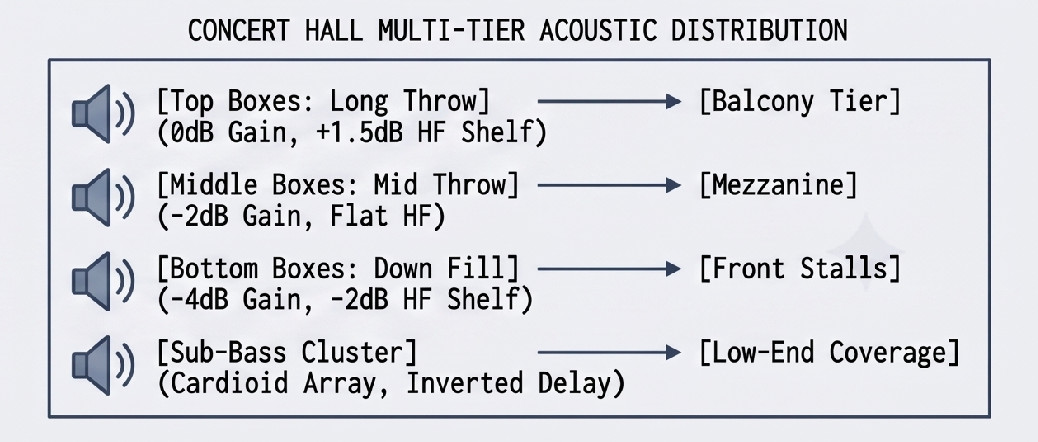
In multi-tier acoustic environments, achieving even SPL distribution without spilling excess energy onto reflective rear walls requires precise zoning.
Commissioning Workflow:
Network Topology Setup: Each amplifier module—such as those integrated into the EGT GL18S-DSP active subwoofer series—is assigned a static IP on the dedicated sound-control subnet.
Impedance Baseline Verification: Before sending high-level pink noise, run an automated low-level pilot-tone sweep via the monitoring software to verify that every HF compression driver and LF woofer is within nominal manufacturer tolerances (e.g., 6–8 $\Omega$ for discrete modules, 16 $\Omega$ for paralleled line array satellites).
Array Compensation Curves: Apply targeted IIR parametric filters:
- Top Long-Throw Cabinets: Compensate for atmospheric HF absorption with a gentle high-shelf boost ($+1.5\text{ dB}$ at $10\text{ kHz}$).
- Bottom Down-Fill Cabinets: Attenuate mid-high gain by $-3\text{ dB}$ to prevent ear fatigue in front-row seating.
- Cardioid Subwoofer Steering: Using the output delay blocks on dedicated subwoofer channels, invert polarity and apply precise millisecond delays (typically 2.4 ms to 3.8 ms depending on physical driver spacing) to the rear-firing cabinets, canceling stage-bleed low-frequency energy while boosting audience-side punch.
The Bottom Line for Contractors and System Integrators
Networked amplification is no longer an optional luxury for high-budget tours; it is the industry benchmark for commercial reliability and operational efficiency. By shifting DSP processing, circuit monitoring, and dynamics limiting directly into the amplifier chassis, audio contractors achieve three decisive commercial advantages:
- Drastically Reduced Rack Space & Cabling Overhead: Eliminates external analog patch bays, outboard graphic EQ racks, and cumbersome multi-core copper trunks.
- Actionable Predictive Maintenance: Identifies transducer degradation or thermal stress before it leads to system failure.
- Instant Scene Recall & Adaptability: Reconfigure a multi-use arena from a corporate speech setup to a full-power live concert in seconds by recalling global network presets.