Introduction: The “Water-Resistant” Myth That Costs Integrators Their Margin
If you have ever pulled a “weather-resistant” line array down from an outdoor coastal stadium rig after two summers, you probably know the sickening sound of delaminating plywood.
On paper, the spec sheet promised “rugged tour-grade textured paint.” In reality, a stagehand clipped the corner of the subwoofer against a steel truck ramp during load-in, gouging a 3-millimeter chip out of the black water-based acrylic finish. Over the next six months of outdoor festivals, afternoon UV baked the cabinet to $65^\circ\text{C}$, and evening rainstorms cooled it right back down. That exposed wood corner acted like a sponge. Moisture wicked into the birch veneers, the glue joints swelled, and suddenly a tight, punchy 18-inch subwoofer started buzzing like a chainsaw at 50 Hz because the internal baffle braces pulled loose.
For indoor theaters, KTV rooms, or conference halls, standard water-based textured paint is great—it is lightweight, eco-friendly, and easy to touch up with a foam roller. However, when you are specifying gear for open-air theme parks, sports stadiums, or heavy rental touring, ordinary paint is merely makeup. To actually seal and armor a wooden acoustic enclosure against physical abuse and extreme weather, modern pro-audio manufacturing relies on two heavy-duty composite materials: two-component sprayed polyurea elastomers and fiberglass-reinforced plastic (FRP).
Core Technical Analysis: Why Polyurea and Fiberglass Beat Traditional Coatings
To understand why contractors are willing to pay more for polyurea and fiberglass finishes, we have to look at what happens at the surface of a speaker cabinet under mechanical and thermal stress.
1. Two-Component Polyurea Spraying: A Seamless Elastomeric Armor
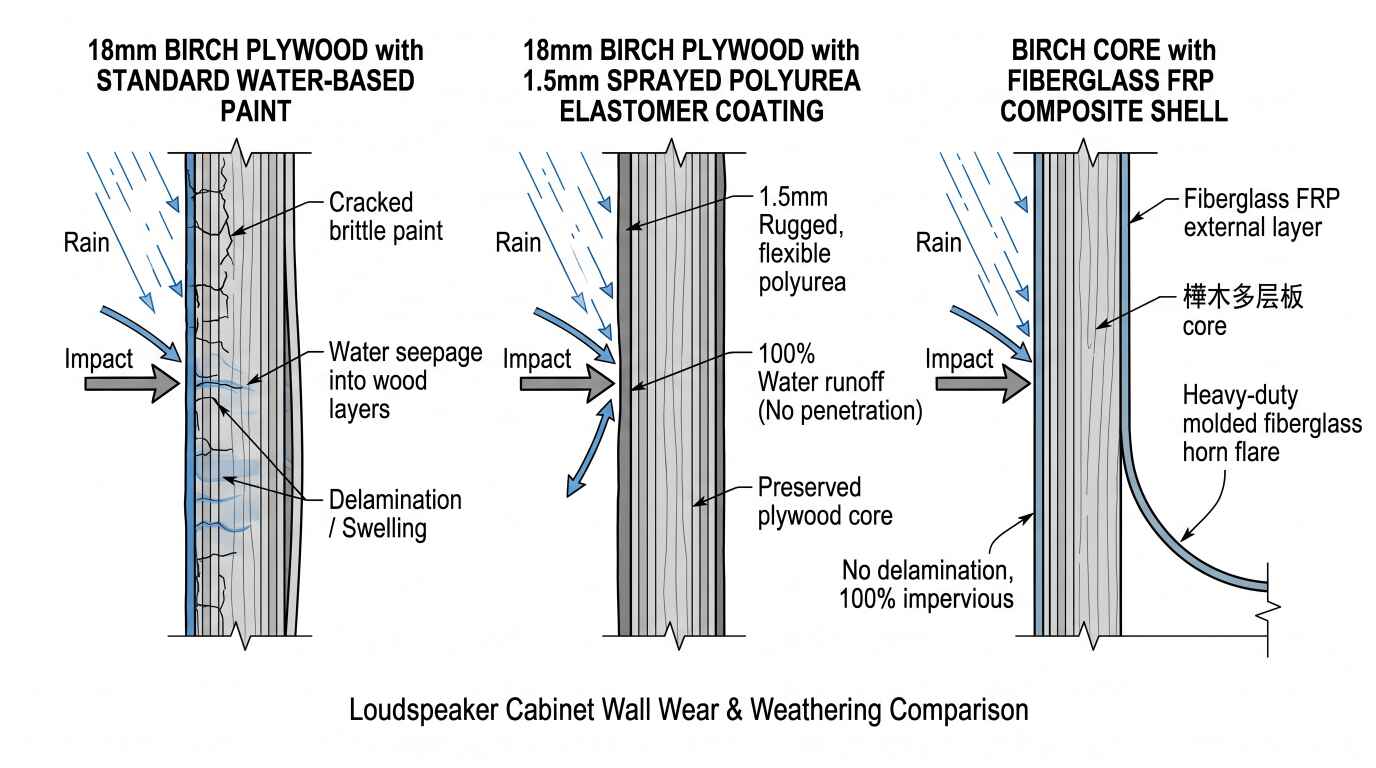
Traditional water-based paint (and even two-part polyurethane paint) dries into a relatively brittle shell. When an 80 kg dual-18 subwoofer is dropped onto a concrete stage lip, the wood compresses slightly under impact, the brittle paint cracks, and water gets in.
Polyurea is completely different chemistry. Applied using specialized high-pressure, high-temperature impingement plural-component spray guns (heated to roughly $65^\circ\text{C}–70^\circ\text{C}$ at over 2,000 PSI), isocyanate and amine resin react on contact to cure in less than 10 seconds.
- Elongation & Impact Absorption: Pure polyurea has a tensile elongation rate of 300% to 400% combined with high Shore D hardness. If a forklift fork grazes a polyurea-coated cabinet, the coating flexes with the wood fibers and rebounds instead of shattering or flaking off.
- Zero-Pinhole Hydrophobic Seal: Because it cures almost instantly without solvent evaporation, polyurea forms a dense, seamless membrane around every routed handle pocket, corner radius, and rigging slot. Water simply cannot reach the birch substrate.
2. Fiberglass (FRP) Composites: Structural Rigidity & Acoustic Waveguides
While polyurea is sprayed onto plywood as an external skin, fiberglass (Glass-Fiber Reinforced Plastic) serves a dual role in outdoor pro audio: either as a hand-laid outer shell encapsulating the wood box, or as the structural material for large-format high-frequency horns and mid-bass waveguides.
- Acoustic Inertness on Large Horns: In long-throw stadium cabinets, high-frequency compression drivers generate massive throat pressure. Cheap injection-molded ABS plastic horns flex and resonate at high SPL, coloring the upper-midrange (1.2 kHz – 3 kHz) with a harsh, “plastic” honk. Thick, compression-molded fiberglass horns are rock-solid, thermally stable under direct sunlight, and completely non-resonant.
- Parasitic Resonance Damping: When fiberglass mat and resin are laminated over birch plywood for permanent outdoor installations, the composite skin increases panel stiffness, pushing unwanted cabinet panel vibrations well above the subwoofer’s operating passband.
Material Performance Comparison Matrix
When advising a project client or writing tender specifications, here is how the four main cabinet finish and material technologies stack up in real-world deployment:
| Technical Metric / Field Property | Standard Water-Based Textured Paint | Two-Part Polyurethane (PU) Paint | Sprayed Polyurea Elastomer | Fiberglass (FRP) Composite / Horn |
|---|---|---|---|---|
| Typical Dry Film Thickness | 0.2 mm – 0.4 mm | 0.4 mm – 0.6 mm | 1.2 mm – 2.0 mm | 2.5 mm – 5.0 mm (Structural) |
| Impact & Scratch Resistance (Shore Hardness) | Low (Chips to bare wood on sharp impact) | Moderate (Good scratch resistance, brittle on heavy drops) | Extreme (Shore D 45–55; absorbs heavy rigging/truck impacts) | Very High (High tensile strength, zero rot) |
| Waterproofing & Humidity Stability | Indoor / Dry portable use only | Splash-resistant (Short-term outdoor) | Seamless waterproof membrane (All-weather touring) | Impervious to water & salt spray (Coastal/Stadium) |
| Acoustic Effect on Cabinet | Neutral | Neutral | Adds slight mass damping to outer wood plies | Eliminates horn flare resonance in long-throw mid/highs |
| Field Touch-Up & Repairability | Easy (Sand and roll in 15 mins) | Moderate (Requires solvent spray) | Hardly ever needs repair; requires 2K patch kit if cut | Requires epoxy/resin patch and gelcoat sanding |
Field Application & Engineering Integration: Matching the Finish to the Job
At our factory, we don’t just spray polyurea or mold fiberglass onto every box—because doing so on a compact KTV speaker would unnecessarily drive up the client’s cost and shipping weight. Instead, we match the composite technology strictly to the mechanical and environmental stress of the application.
1. High-Frequency Touring & Outdoor Line Arrays: Birch Plywood + Polyurea Armor
Take a touring line array or a mobile robotic system that gets rolled in and out of trucks four times a week, often caught in sudden outdoor downpours. Here, weight-to-strength ratio and impact resilience are everything.
Engineering Implementation: In our VK Series passive line arrays (such as the dual-10-inch VK210 delivering 135/140 dB Max SPL, and the VK218S dual-18-inch 1200W/4800W subwoofer), we start with void-free multi-layer Birch Plywood and seal the exterior with Waterproof Polyurea Paint. Even when ground-stacking VK218S subs on wet festival grass or flying 12 boxes of VK210 in humid tropical climates, the polyurea skin prevents the wood joints from absorbing moisture and swelling around the precision four-point rigging hardware.
Heavy Mobile Systems: Similarly, for the EASY-1018 Active Electric Robotic Lifting Line Array System—a 100 kg all-in-one unit housing an 18-inch sub, dual 10-inch coaxial neodymium tops, a $2\times 1200\text{W}$ Class-D amplifier, and a motorized lifting column—we construct the enclosure from 18mm high-density multi-layer plywood sprayed with polyurea waterproof paint behind a 1.5mm high-strength steel mesh. Because mobile rental crews constantly wheel this 100 kg cabinet over rough pavement and outdoor plazas, the polyurea coating acts as a built-in bumper guard.
2. Long-Throw Stadium Point Sources: Custom Fiberglass Acoustic Horns
When you move from a festival line array to a permanent outdoor sports stadium or open-air arena, throw distance and horn rigidity become the primary bottleneck.
- Engineering Implementation: In our POW Series medium-and-long-range stadium loudspeakers (such as the 3-way dual-15-inch POW-825 rated at 1000W/3200W and 134 dB Max SPL), we utilize a specially custom-molded oversized fiberglass sound reinforcement horn. At 134 dB+ continuous output, that large fiberglass horn flare maintains exact geometric stability without flexing, allowing the mid-high frequencies to punch through wind and crowd noise over long stadium throws without harmonic distortion.
Pro Tips & Field Traps: How Not to Get Burned by “Fake” Weatherproofing
If you are an integrator bidding on an outdoor project or inspecting factory samples, watch out for these three industry traps:
1. The “Fake Polyurea” Polyurethane Trick
True polyurea requires a machine that costs tens of thousands of dollars and a skilled operator wearing full respiratory gear. Many budget workshops spray thick, high-build two-part polyurethane (PU) or even textured epoxy and label it “Polyurea” on the spec sheet.
- How to spot it in 5 seconds: Ask the factory for a cured sample strip of the coating peeled off a test board, or take a key to the bottom skid area of a sample subwoofer. True polyurea feels slightly rubberized yet tough—you can bend a free film strip $180^\circ$ back on itself without it snapping. Fake PU paint will crack and leave a white stress mark the moment you flex it or strike it with a metal tool.
2. Aliphatic vs. Aromatic Polyurea Under Direct Sunlight
Standard pure polyurea is aromatic, which means its molecular structure is practically indestructible against water and physical impacts, but it is UV-sensitive. If you hang a black aromatic polyurea speaker in direct equatorial sunlight for a year without a UV topcoat, it won’t lose its waterproof seal, but the jet-black finish will chalk and fade to a dull, patchy brownish-gray.
- Field Rule: If your speakers will be flown under a shaded stadium roof or used for portable touring, standard aromatic polyurea is perfect. If they will be bolted to an unshaded light pole in the sun 365 days a year, specify an aliphatic UV-stable topcoat over the polyurea base.
3. Sealing the Box While Leaving the Grille and Connectors Wide Open
A polyurea-coated cabinet is only as waterproof as the holes you cut into it. Water cannot penetrate the polyurea walls, so during a driving rainstorm, it goes straight through the front grille onto the paper woofer cones, or trickles down the speaker cable into the rear Speakon plate.
- The Fix: Always pair polyurea cabinets with a 1.5mm powder-coated steel grille backed by open-cell hydrophobic acoustic foam (which lets sound out while breaking up rain droplets), angle outdoor point-source hangs downward by at least $5^\circ$ so water drains out the bottom of the horn rather than pooling in the compression driver throat, and use drip-loops on all rear PowerCON and Neutrik Speakon cables.
Industry Conclusion
Acoustic engineering does not stop at the crossover network or the voice coil gap—it has to survive the real world. By reserving standard water-based textured finishes for climate-controlled indoor venues, deploying sprayed polyurea elastomers on birch plywood touring arrays, and utilizing rigid fiberglass waveguides for long-throw stadium horns, system integrators can guarantee that the sound system they commission on Day 1 still delivers the exact same SPL and tonal balance in Year 5.