Every pro audio contractor or system integrator has faced that dreaded Monday morning phone call: “Kenny, the system sounded great last night during the main band’s set, but halfway through the encore, the high-frequency drivers just died.”
You drive out to the venue, pull the compression drivers, and there it is—the unmistakable, acrid smell of a burnt voice coil.
The immediate reflex for many system operators is to blame the amplifier for being “too powerful.” But as any seasoned audio engineer will tell you, the culprit is almost always the exact opposite. Underpowering an audio system, combined with aggressive signal clipping, is the number one killer of high-frequency tweeters.
Let’s break down the real physics of power matching so you can design systems that sound pristine and run reliably for years without blowing drivers.
The Root Cause: Why “Small” Amps Destroy High-Frequency Drivers
To understand tweeter burnout, we have to clear up a massive industry misconception. A speaker driver doesn’t burn out simply because an amplifier is capable of delivering high wattage. It burns out because the amplifier is forced into a state of clipping.
The Anatomy of a Clipped Signal
When a sound system is pushed beyond its voltage limits, the smooth, undulating sine waves of music hit a hard ceiling. The amplifier runs out of headroom and literally “clips” off the tops and bottoms of the waveforms, turning them into square waves.
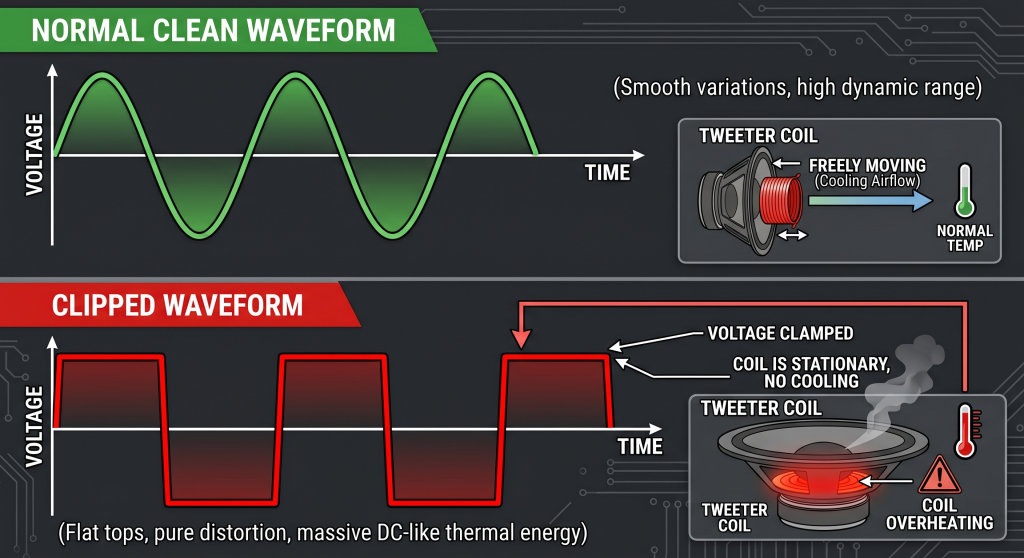
This introduces two catastrophic problems:
- The Distortion Explosion: A clipped square wave creates a massive spike in high-frequency harmonics that weren’t in the original audio signal.
- Thermal Overload: In a clean signal, the voice coil moves back and forth, allowing air to cool it. When a wave is clipped, the flat top means the voltage stays constant for a fraction of a second. The voice coil stops moving but continues to draw massive current, acting like a heating element in a toaster.
Because high-frequency drivers (tweeters) are physically smaller and use much thinner wire in their voice coils compared to subwoofers, they cannot dissipate this sudden surge of pure thermal energy. The adhesive melts, the wire shorts, and your tweeter is toast.
The Golden Rules of Power Matching
To protect your system, you must follow the industry-standard headroom rule. As a golden rule for live sound, commercial integration, and performance venues, your power amplifier should have an RMS output capacity of 1.5 to 2 times the continuous (AES/RMS) power rating of the speaker.
$P_{\text{amp}} = (1.5 \sim 2) \times P_{\text{speaker (RMS)}}$
This ensures that the amplifier has enough “clean headroom” to reproduce transient audio peaks (like a sudden snare hit or a vocalist dropping the mic) without flattening the waveform into a dangerous square wave.
How to Calculate the Match: A Real-World Table
| Speaker Type / Specification | Ideal Amplifier Power (Per Channel @ Matching Impedance) | Selection Logic |
|---|---|---|
| Small-Scale / Auxiliary e.g., EGT GF-6.5 (180W RMS @ 8 $\Omega$) |
300W – 350W into 8 $\Omega$ |
Provides pristine transient headroom for background music and clear speech presentation without clipping. |
| Mid-Tier Performance e.g., EGT TX-12 (400W RMS @ 8 $\Omega$) |
600W – 800W into 8 $\Omega$ |
Ensures the 44mm voice coil tweeter gets clean, unclipped high-frequency transients during live dynamic peaks. |
| High-Output Main Speaker e.g., EGT RX-215 (800W RMS @ 4 $\Omega$) |
1200W – 1600W into 4 $\Omega$ |
Dual 15-inch woofers demand immense current; a robust amp prevents low-frequency sag from distorting the whole cabinet. |
Field Guide: Equipment Selection & Scenario Matching
Different venues present entirely different acoustic challenges and power distribution demands. Here is how we look at equipment selection across three common commercial environments:
1. Corporate Conference Rooms & Lecture Halls
- The Goal: Absolute speech intelligibility and zero system noise.
- The Gear: In these environments, you want a highly efficient, multi-channel amplifier paired with pristine co-axial or column enclosures.
- The Match Engineering: For a standard system, pairing an EGT AK4600 four-channel amplifier (which outputs a clean 600W per channel at 8 $\Omega$) with our EGT FX-12 co-axial conference speakers (rated at 250W Continuous) gives you just under 2.5x headroom. This guarantees that even if a presenter yells into the lapel mic, the system reproduces the peak cleanly with zero harmonic distortion or tweeter risk.
2. Live Performance Venues & Nightclubs
The Goal: High Sound Pressure Levels (SPL) and continuous, hard-hitting dynamics.
The Gear: Heavy-duty touring cabinets paired with premium H-class or D-class intelligent power matrices.
The Match Engineering: Take our high-performance EGT TR-12 professional speaker, which sits at 350W Continuous with a 1.4-inch compression driver. To run this flawlessly in a high-energy environment, we recommend deploying the EGT BH800 power amplifier. Delivering 800W per channel at 8 $\Omega$, the BH800 gives the TR-12 the perfect 2.2x power ratio, allowing the speaker to safely reach its maximum rated 129dB SPL without a hint of signal degradation.
3. Large-Scale Stadiums & Outdoor Concerts
The Goal: Massive throw distance, cohesive wavefronts, and bulletproof weather-resistant reliability.
The Gear: Multi-cabinet passive or active line array systems backed by extreme low-frequency subwoofer arrays.
The Match Engineering: For large venues, systems like our Nezha Series E-LY212 dual 12-inch line array require precision bi-amplified or optimized power routing. The low-frequency section runs at 800W Continuous, while the dual 75-core neodymium high-frequency drivers handle 180W Continuous. We match these to our high-power DM Series or KH Series digital amplifiers, integrating brick-wall peak-clipping limiters via DSP to protect the array across thousands of hours of high-volume operation.
Pro Acoustic Tips: Avoiding Common “Field Traps”
⚠️ The Multi-Speaker Impedance Trap
When contractors daisy-chain passive speakers in parallel, the total impedance drops. Wiring two 8 $\Omega$ speakers together drops the load to 4 $\Omega$. If you wire four 16 $\Omega$ cabinets in parallel (like our EGT GL210 line array modules), the load drops to 4 $\Omega$. Always recalculate your amplifier’s output power based on the final combined impedance, not the single cabinet sticker rating.
Engineering Solution: The Active Safety Net
If your venue is operated by non-technical staff or rotating guest DJs who love to push mixers into “the red,” consider moving away from external power matching entirely.
Our GL DSP Series and VKX DSP Series active line arrays feature custom-tailored, built-in Class-D digital amplifiers with factory-set, root-mean-square (RMS) compression and peak clipping protection algorithms. The DSP knows exactly when the high-frequency drivers are approaching their thermal limits and transparently clamps the signal, making tweeter burnout practically impossible—no matter how hard the operator drives the input console.
Summary for Project Integration
When drafting your next equipment procurement or system design proposal, keep these three structural checklist rules in mind:
Never Underpower: Ensure your amplifier power capacity comfortably exceeds the speaker’s continuous AES/RMS rating by a factor of 1.5 to 2.
Verify Impedance Loads: Confirm the amplifier’s wattage output profile matches the exact aggregated speaker load (4 $\Omega$, 8 $\Omega$, or 16 $\Omega$).
Deploy System Limiters: If using passive systems, properly configure your external DSP output limiters to match the maximum voltage thresholds of your high-frequency components.
By respecting the thermal and electrical realities of audio reinforcement, you save your clients from costly downtime and keep your reputation for delivering crystal-clear, rock-solid audio installations completely intact.
Have a challenging venue layout or complex system match coming up? Reach out to our engineering support team at EGT Audio, and we’ll help you map out the perfect acoustic and electronic blueprint for your project.